
Aesthetic Social Content Ideas for Estheticians That Actually Book Appointments (Beyond Templates!)
If you've been relying on pretty aesthetic social content & templates for estheticians to fill your content calendar, you've probably noticed something frustrating: your feed looks beautiful, but your appointment book stays empty.
Here's why: templates give you what to post, but they don't teach you how to create content that converts followers into booked clients.
The estheticians booking consistently aren't just posting pretty graphics. They're strategically creating content that moves potential clients through a decision journey—from awareness to consideration to "I need to book NOW."
Let's break down the spa marketing content ideas that actually drive bookings, and how to execute them with strategic intention (not just aesthetic appeal).
1. Before-and-After Transformations (But Make Them Strategic)
Yes, transformation posts work—but not the way most estheticians are doing them.
What doesn't work: Posting a before-and-after photo with a generic caption like "Amazing results! ✨ Book your facial today!"
What actually books clients: Transformation posts that tell the strategic story:
The specific problem the client came in with (hormonal acne, hyperpigmentation, dehydrated skin)
Why that problem wasn't resolving with their previous routine (wrong products, missing professional treatments, lifestyle factors)
Your unique treatment protocol (what you did differently that got results)
The timeline and realistic expectations (how many sessions, what they did at home)
The emotional transformation, not just the visual (how they felt before vs. after)
Example caption structure:
"Sarah came to me after spending $400 on trendy skincare products that made her cystic acne worse. Her moisture barrier was compromised from over-exfoliation, and her skin was inflamed and painful.
Here's what we did differently: [Your specific protocol]. After 6 weeks and 3 facials, her skin is calm, clear, and she finally feels confident without makeup.
If your skin is reacting to everything and nothing seems to work, you might be dealing with the same barrier damage. I have 2 consultation spots available this week. DM me CONSULT to discuss your specific situation."
Why this works: It speaks to a specific ideal client, demonstrates your expertise, creates hope, and includes a clear, urgent call-to-action.
This isn't content you'll find in aesthetic social templates—because it requires your unique methodology and authentic client stories.
2. Educational Content That Positions You as THE Expert
Social media templates for estheticians often include generic "skincare tip" graphics. But educational content that actually converts goes deeper.
Skip the generic tips like:
"Drink water for glowing skin! 💧"
"Don't forget SPF! ☀️"
"Exfoliate weekly! ✨"
Create expert positioning content like:
Myth-busting posts that challenge common skincare beliefs your ideal clients hold
"Why your routine isn't working" breakdowns that diagnose common problems
Treatment comparison content that explains why your approach is superior
Ingredient deep-dives that demonstrate your clinical knowledge
Skin analysis education that helps people identify their actual skin type vs. what they think it is
The goal: Make potential clients think, "Wow, I had no idea. I need to work with someone who actually understands this."
Your educational content should be so valuable and specific that it becomes clear you're not just an esthetician—you're a skincare problem-solver they can't get results without.
Pro tip: Your educational posts should naturally lead to the realization that they need professional treatment. Don't just educate for education's sake—educate to create demand for your services.
3. Instagram Stories That Create Booking Urgency (Not Just Engagement)
Aesthetic content clubs often provide story templates with polls, quizzes, and "this or that" slides. These create engagement but rarely drive appointments.
Instead, use Stories strategically:
Scarcity-based Stories:
"I have 3 last-minute cancellations this week. First 3 DMs get these spots at 20% off."
"Opening my November schedule tomorrow at 10am. Set your alarm if you want a spot before Thanksgiving."
"Taking last-call appointments for my signature [treatment name] before I pause bookings for the holidays."
Behind-the-scenes Stories that build desire:
Show your treatment room setup for an upcoming appointment
Film yourself preparing custom treatment cocktails
Share the moment a client sees their skin after treatment (with permission)
Reveal a new treatment or product you're introducing
Problem-agitation Stories:
"If you're seeing this texture on your skin, here's what's actually happening..." (educate, then offer solution)
"Your skin is going to hate you this winter if you don't do this one thing..." (create concern, provide answer)
"I had 3 clients this week dealing with [specific problem]. Here's what we're doing about it..."
The difference: These Stories don't just engage—they create urgency, demonstrate value, and give people a reason to book NOW instead of "someday."
4. Engagement Content That Qualifies Leads (Not Just Collects Likes)
Most spa marketing content focuses on getting likes, comments, and saves. But engagement that doesn't lead to bookings is just vanity metrics.
Transform engagement into qualification:
Instead of: "What's your biggest skincare struggle? Drop it in the comments! 💬"
Try: "Comment STRUGGLE and I'll send you my free guide: 'The 5 Reasons Your Skincare Routine Isn't Working (And What To Do Instead)'"
This approach:
Gets engagement (which helps your reach)
Moves people into your DMs (where conversions happen)
Qualifies interest (they're actively seeking solutions)
Gives you follow-up opportunities (you can continue the conversation)
Other qualifying engagement ideas:
"DM me CONSULTATION for my pre-booking skin analysis questionnaire"
"Comment READY if you're finally serious about clearing your acne, and I'll share my available appointment times"
"Drop a 🙋♀️ if you want to know if my [specific treatment] is right for your skin type"
This is strategic engagement. You're not just collecting comments—you're identifying potential clients and opening conversation pathways.
5. Consistency That Serves Strategy (Not Just Aesthetics)
Yes, consistency matters. But consistent what?
Aesthetic social templates help you post consistently. But if you're consistently posting the wrong content at the wrong time, you're just wasting effort.
Strategic consistency means:
Content Sequencing Over Visual Perfection: Instead of posting content based on how it looks in your grid, post based on where your audience is in the decision journey.
Week 1: Problem awareness content Week 2: Solution education content
Week 3: Social proof and transformation content Week 4: Direct booking invitation with urgency
Timing Based on Booking Behavior: Analyze when your followers are most likely to book:
Monday mornings (fresh start mindset)
Payday Fridays (discretionary income available)
Sunday evenings (self-care planning mode)
Post your conversion-focused content during these high-intent windows.
Consistency in Brand Voice, Not Just Visual Style: Your content should be instantly recognizable as yours because of:
Your unique perspective and personality
The specific way you explain concepts
Your authentic voice and communication style
The transformation stories you tell
This consistency builds trust and authority—which converts better than a perfectly curated grid.
6. FAQ Content That Removes Booking Objections
Answering skincare questions builds authority, yes. But strategic FAQ content specifically addresses the objections preventing people from booking.
Generic FAQ: "What's the difference between a basic facial and a deluxe facial?"
Strategic FAQ that converts: "Why my facials are $135 (and why discounted facials might be costing you more in the long run)"
This addresses the price objection head-on, educates on value, and positions your pricing as an investment, not an expense.
Other strategic FAQ topics:
"How often should you really get facials?" (creates demand for ongoing appointments)
"What to expect at your first appointment" (removes new client anxiety)
"Can I wear makeup after a facial?" (addresses practical concerns)
"How do I know which treatment is right for me?" (opens consultation conversation)
The goal isn't just to answer questions—it's to remove the friction points preventing someone from clicking "book now."
7. Experience Differentiation Content (Your Secret Weapon)
This is where you separate yourself from every other esthetician using the same aesthetic social templates.
Don't just say: "My facials are more than just facials ✨"
Show specifically what makes your approach different:
"Why I spend 15 minutes on skin analysis before touching your face (and most estheticians don't)"
"The difference between a $60 facial and my $135 treatment—broken down step-by-step"
"Here's what happens in my treatment room that you won't experience anywhere else"
"My signature [treatment name] protocol: why this combination gets results"
Share the details that make someone think, "I can't get this experience anywhere else. I need to book with HER."
This content can't come from templates because it's uniquely yours. It's your methodology, your personality, your treatment room, your client experience.
Example of powerful differentiation content:
Instead of a generic post about "relaxing facials," create a detailed breakdown:
"Here's what actually happens during my 90-minute signature facial (and why it's worth every penny):
Minutes 1-15: Deep skin analysis with magnification and consultation. I'm looking at texture, congestion patterns, barrier health, and sensitivity triggers most estheticians miss.
Minutes 16-30: Custom double cleanse based on what I found in analysis. Not the same cleanser for everyone—your skin gets what it specifically needs.
Minutes 31-50: Extractions if needed, but only after proper prep. I'm never rushing this or forcing anything.
Minutes 51-70: Treatment mask cocktailed specifically for your concerns. This is where the magic happens—and why you can't replicate these results at home.
Minutes 71-90: Massage, serums, SPF, and your customized home care plan. You leave knowing exactly what to do until your next appointment.
This isn't just a facial. It's a strategic treatment plan for your specific skin."
Why this works: You've just educated potential clients on what quality esthetics looks like, justified your pricing, and made them realize their $60 discount facial isn't giving them this level of expertise.
Generic aesthetic social templates can't teach you to create this level of differentiation—because they're designed to work for any esthetician. Your competitive advantage is in the details they can't template.
The Real Difference Between Template Content and Strategic Content
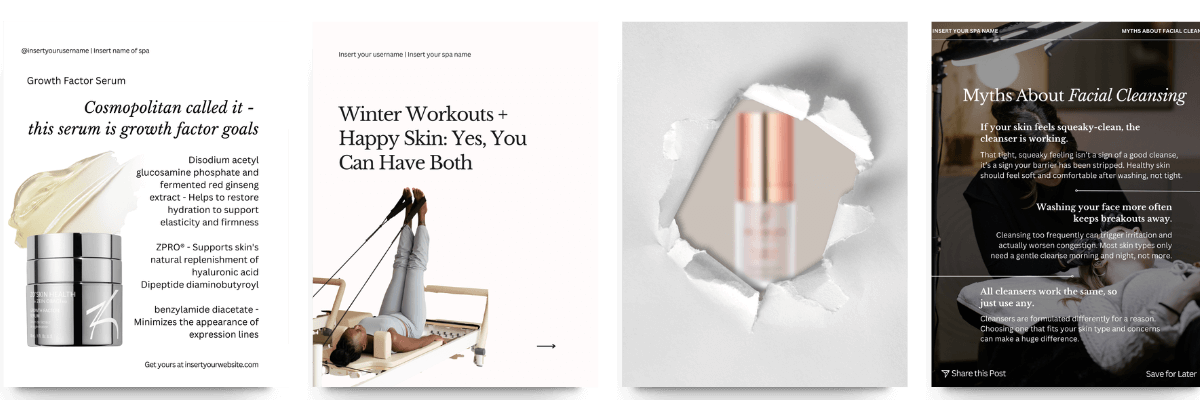
Here's what I want you to understand: Aesthetic social templates give you content to post. Strategic content gives you appointments to book. In The Esti Content Club, you get both. Beautifully professionally designed content with strategy to make your content go further.
Your Action Plan: Content That Converts
Here's how to implement these ideas starting today:
Audit your last 20 posts - How many were designed to drive bookings vs. just look pretty?
Create a content strategy calendar - Plan posts based on buyer journey stages, not just aesthetics
Write 3 transformation story captions - Using the strategic framework from tip #1
Develop your FAQ content - Focus on booking objections, not just general questions
Identify your unique differentiators - What makes your experience different? Create content around that
Track what actually books clients - Stop measuring success by likes. Track DMs, consultation requests, and booked appointments
The estheticians with full schedules aren't just posting consistently—they're posting strategically. They understand that content is a tool to move people toward booking, not just a way to maintain an aesthetic feed.
Ready to Create Content That Actually Fills Your Schedule?
THE ESTI CONTENT CLUB® teaches licensed estheticians and medical estheticians how to create strategic, conversion-focused content that books appointments, not just collects saves.
You'll learn:
How to plan content based on buyer psychology, not templates
Strategic caption frameworks that drive booking action
How to position your unique approach in every post
Content sequencing that moves followers to clients
Analytics that matter: tracking bookings, not just engagement
Stop renting content ideas from templates. Start building strategic content that grows your business.
Join THE ESTI CONTENT CLUB® and learn content strategy that converts!