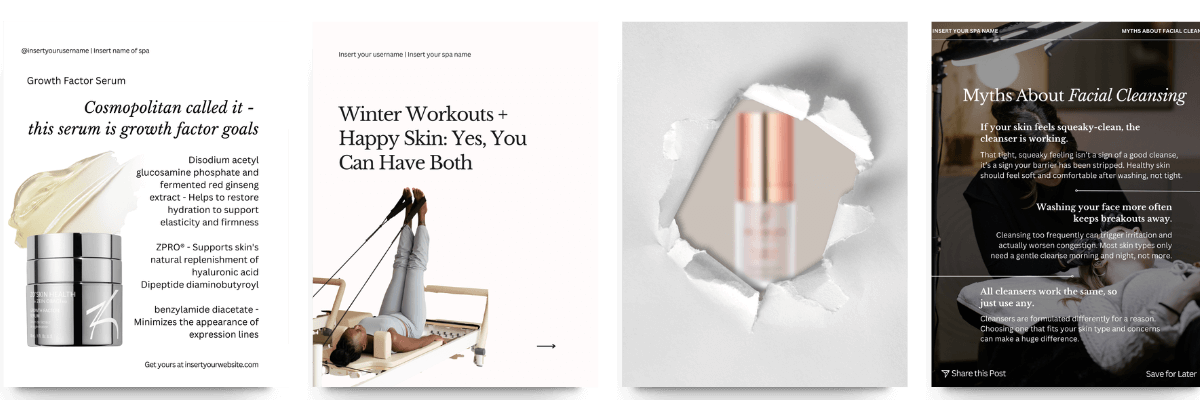
Aesthetic Social Templates for Estheticians: Do They Actually Book Clients?
You finally found them. The perfect aesthetic social templates for estheticians. The colors are dreamy, the fonts are elegant, the layouts are Instagram-worthy. You download the pack, customize a few text boxes, and post.
Your feed transforms overnight. Cohesive. Polished. Professional. The aesthetic is chef's kiss.
But three months later, you're staring at your analytics with a sinking feeling. High saves. Decent engagement. Beautiful grid. Empty appointment book.
Here's the truth that most template sellers won't tell you: Having an aesthetic feed and having the RIGHT aesthetic that matches your brand and attracts your ideal clients are two completely different things.
Beautiful templates can give you visual consistency, but without a strong brand foundation underneath, even the most gorgeous aesthetic won't book appointments. And if your aesthetic doesn't align with what your specific clients are drawn to, you're just creating pretty content for the algorithm—not for real people with booking intent.
Why Aesthetic Matters (But Templates Aren't Enough)
Let's be clear: aesthetic content for Estheticians absolutely matters. Your visual brand is doing massive psychological work before a potential client ever reads a caption.
Your aesthetic communicates:
Your price point and positioning
Your treatment philosophy (clinical vs. holistic vs. wellness-focused)
Who you serve (your ideal client demographic)
Your professionalism and expertise level
Whether you're approachable or intimidating
When someone discovers your profile, they decide in 3-5 seconds whether you're "for them" based purely on visual cues. That's why having a cohesive, strategic aesthetic matters.
But here's the problem: Aesthetic social templates give you visual consistency. What they can't give you is the brand clarity that determines WHICH aesthetic actually attracts your ideal clients and makes booking feel like the natural next step.
The Fatal Flaw: Templates Give You "An Aesthetic" But Not "Your Aesthetic"
Here's where estheticians get stuck: You choose templates because they're beautiful. Soft neutrals with gold accents. Minimalist layouts. Elegant serif fonts. They look professional—exactly what you think an esthetician's feed "should" look like.
But you never asked: Does this aesthetic match the brand I'm building and the clients I want to attract?
Aesthetic social templates are designed to appeal to thousands of estheticians, so they default to universally appealing styles:
Soft, neutral color palettes (blush, cream, sage, taupe)
Minimalist layouts with lots of white space
Delicate serif or script fonts
Dreamy, elevated, spa-like vibes
This works beautifully if you're positioning as luxury. But what if that's not your brand?
What if:
You specialize in acne treatment for teens (who find that aesthetic too mature)
You focus on results-driven clinical treatments (and need to communicate science, not just relaxation)
You want to be the approachable neighborhood esthetician (and need warmth, not untouchable luxury)
You serve busy professionals who value efficiency (not indulgent spa vibes)
You're building a personal brand around your unique personality (and generic templates hide what makes you different)
Using the wrong aesthetic—even if it's beautiful—is worse than no strategy at all. You're attracting the wrong audience or making your ideal clients think you're not "for them."
What Strong Branding Actually Means (And Why Templates Can't Provide It)
Your brand is the strategic foundation that answers:
1. Who You Serve - Your ideal client's demographics, psychographics, pain points, and decision-making style
2. What You Stand For - Your unique treatment philosophy, what makes you different, and the transformation you provide
3. How You Want to Be Perceived - Are you the luxury experience, the trusted expert, the approachable girlfriend, or the results-driven specialist?
4. What Experience You Promise - What clients can expect emotionally and functionally when they book with you
Once you have this brand clarity, THEN you determine what aesthetic serves that brand.
Aesthetic social templates work backwards. They give you a pre-made visual style and force your messaging to fit it. That's why so many estheticians using templates end up sounding and looking like everyone else—they're adapting to the template instead of creating content that authentically represents their unique brand.
The "Approachable Brand" Aesthetic Challenge
Many estheticians want to position as:
Expert but not intimidating
Professional but not cold
Quality-focused but not unattainably expensive
Trustworthy but not boring
This is the "approachable expert" brand position. And most aesthetic social templates completely miss this positioning.
An approachable aesthetic requires:
Colors that feel welcoming: Warm neutrals instead of cool grays, friendly accent colors (soft coral, sage, dusty blue), inviting tones that don't feel sterile or dramatic
Typography that's accessible: Clean sans-serifs, good readability, consistent hierarchy—not overly decorative scripts that feel exclusive
Layouts that invite engagement: Strategic white space that breathes, balanced compositions, your face and personality visible, conversational text overlays
Imagery that humanizes: Real client experiences, behind-the-scenes content, natural lighting, your actual treatment room, authentic moments
Design that removes friction: Enough polish to signal professionalism, enough personality to signal relatability, visual cues that say "you belong here"
Most aesthetic social templates default to aspirational luxury because that's what photographs well and gets saves. But if your brand is approachable expertise, that aesthetic creates cognitive dissonance. Your ideal client thinks "that's beautiful, but it's not for me."
Why Brand-Aesthetic Alignment Actually Books Clients
Scenario 1: The Mismatch
Emily is 28, struggling with hormonal acne, looking for an esthetician who understands acne treatment—not just relaxing facials.
She finds an Instagram with a soft, dreamy, spa-like aesthetic. Lots of "self-care Sunday" content and inspirational quotes.
Her reaction: "This looks like a place for people who already have nice skin. They probably don't specialize in acne like mine. I need someone more clinical."
She keeps scrolling. Lost client.
Scenario 2: The Match
Sarah, also 28 with hormonal acne, finds a different esthetician.
The aesthetic is clean, modern, and approachable. Warm, friendly tones. Real before-and-afters with detailed treatment explanations. The esthetician's face appears regularly, explaining acne science like a knowledgeable friend. Clear, educational graphics.
Sarah's reaction: "This person gets it. She understands my exact problem. She seems approachable—I could ask questions. And she clearly knows what she's doing. I'm booking."
The difference? Brand-aesthetic alignment.
The second esthetician's aesthetic serves her brand position as an approachable acne specialist. Every visual choice reinforces: "I'm an expert in your exact problem, and you'll feel comfortable working with me."
The 5 Aesthetic Content Mistakes That Kill Facial & Laser Bookings
1. Designing for Your Taste Instead of Your Client's Preferences
You love minimalist Scandinavian design. But your 45-year-old anti-aging client is drawn to warmth and richness. Your minimalist aesthetic feels cold to her.
The fix: Design for your client's preferences, not yours. Research what visual styles resonate with your demographic.
2. Using a "Luxury" Aesthetic When You're Not Positioned as Luxury
If your pricing is mid-market and your messaging is approachable, a luxury aesthetic creates confusion. Clients assume you're too expensive and scroll past.
The fix: Match your aesthetic to your actual positioning. "Professional quality you can access" requires a different visual language than "exclusive luxury."
3. Following Trends Instead of Building Consistency
This month's templates are maximalist Y2K. Next month, cottagecore. You're trendy but confusing—there's no brand recognition building over time.
The fix: Choose an aesthetic that evolves but remains fundamentally consistent. Trends can inform accents, but your core brand aesthetic should be recognizable.
4. Prioritizing Grid Perfection Over Booking Psychology
Your perfectly curated grid with alternating color patterns? Gorgeous. Ineffective at driving appointments.
Booking requires strategic content sequencing—awareness, consideration, decision content in the right order. But you're posting educational content on Tuesday because that's where the blue graphic goes.
The fix: Let strategy dictate content order, then apply your aesthetic. Your grid might be less "perfect," but your booking rate will improve.
5. Creating Visual Intimidation Instead of Invitation
Your aesthetic is flawless. Every post is perfectly designed, professionally photographed, impeccably edited.
But potential clients feel intimidated. They think "everyone there must look perfect" or "I'm not polished enough for that environment."
The fix: Build approachability into your aesthetic intentionally. Show real moments, include behind-the-scenes, let your personality through. An approachable aesthetic says "you belong here, exactly as you are."
What to Do If Your Aesthetic Isn't Booking Clients
Step 1: Audit Your Brand-Aesthetic Alignment
Does my aesthetic match my brand positioning and price point?
Would my ideal client be drawn to this visual style?
Does my aesthetic communicate the experience I actually deliver?
Am I accidentally attracting the wrong clients or repelling the right ones?
Step 2: Research Your Ideal Client's Aesthetic Preferences
What brands do your best clients love?
What aesthetics dominate in other industries they spend in?
What do clients say drew them to you—visual attraction or personality/expertise?
What aesthetic patterns exist among booked-solid estheticians in your area?
Step 3: Create Your Own Aesthetic Guidelines
Don't rely on templates. Build your unique visual brand:
Strategic Color Palette: 2-3 primary colors reflecting your positioning, 2-3 accent colors adding approachability, neutral bases, all chosen for color psychology
Typography System: One primary font for headlines reflecting brand personality, one complementary font for readability, consistent hierarchy
Photography Style: Lighting preferences, subject matter focus, editing style that enhances without becoming unrecognizable
Layout Principles: White space that feels right for your brand, text-to-image ratios, appropriate design complexity
Content Mix: Balance of educational, promotional, personal content that shows your personality and builds approachability
Once you have guidelines, you can use templates as starting points—but customize them to match YOUR aesthetic, not accept them as-is.
The Bottom Line: Strategy Creates Aesthetic, Not the Other Way Around
Aesthetic consistency alone doesn't book appointments. Strategic consistency that serves a clear brand position books appointments.
The estheticians who book consistently don't just have aesthetic feeds. They have strategically aesthetic feeds built on strong brand foundations.
Their visual choices aren't arbitrary or trend-based. Every color, font, layout, and image is intentionally selected to:
Resonate with their specific target audience
Reinforce their positioning and differentiation
Remove barriers to booking
Build recognition and trust over time
Support conversion-focused content
This level of strategic aesthetic development cannot come from a template library. It requires knowing your brand deeply, understanding your clients intimately, and making visual choices that serve both.
Ready to Build an Aesthetic That Actually Converts?
The Esti Content Club® teaches licensed estheticians how to develop strong brand foundations and create strategic aesthetics that book appointments—not just collect saves.
Instead of giving you templates to copy, we teach you:
How to define your unique brand position and ideal client
The psychology of color, typography, and design for your specific audience
How to create an approachable aesthetic that converts
Strategic content frameworks that align visual and messaging strategy
How to build brand consistency that drives bookings and retail sales
You'll learn to create an aesthetic that's uniquely yours, strategically sound, and measurably effective at growing your esthetician business.
Because the goal isn't just to make your feed look pretty. The goal is to make your business profitable.
Join The Esti Content Club® and build a brand aesthetic that books!